Undoubtedly, the Speedmaster is the model that has largely shaped Omega into the brand it has become over the past decades, and for this reason, it is the first model that comes to mind for almost every watch enthusiast whenever Omega is mentioned.
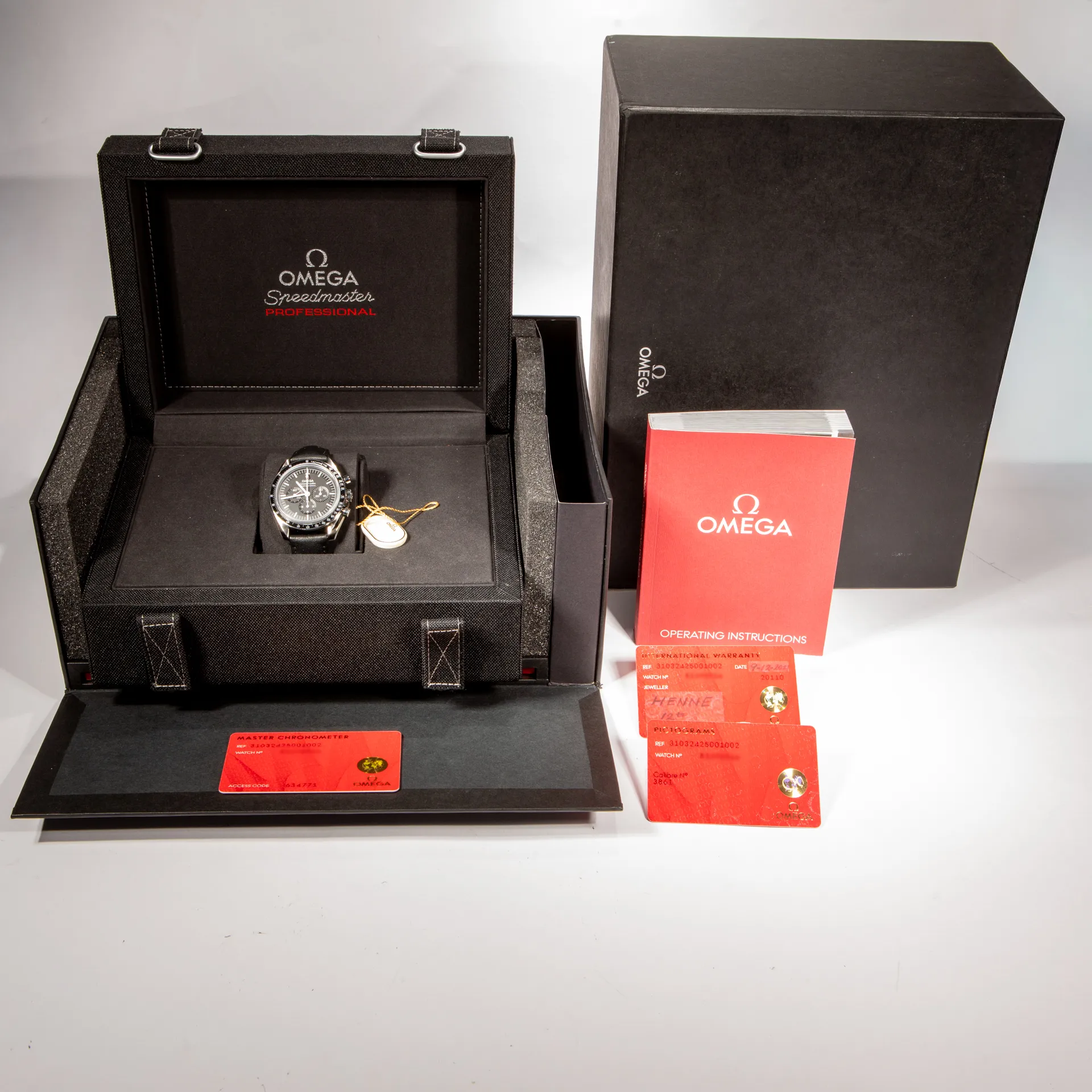
Today we have the pleasure of presenting a new interpretation of that famous Omega watch to which the brand owes much of its popularity – the Omega Speedmaster Moonwatch Professional Co-Axial 42 mm. This is the latest version of the legend, in which the manufacturer has managed to modernise the model without making the changes intrusive or disturbing its classic appearance. Introduced at the beginning of 2021, this is the so-called “Hesalite” version – the closest in spirit to the original Moonwatch models – featuring an acrylic crystal, solid caseback and, of course, a manually wound movement descended from the renowned Lemania calibres. We are certain that for most of us, the words “Omega Speedmaster” immediately bring this exact design to mind, and it is precisely for this reason that the manufacturer has taken great care not to disappoint enthusiasts by preserving its fundamental appearance.
We will try to draw your attention to the differences between the new and previous generations – in our opinion, this is the best way to demonstrate the model's evolution.
The new dial layout is similar to that of its predecessor, but the latest version has acquired an additional vintage character – most noticeably along the boundary between the main dial and the minute track. Here Omega have returned to the characteristic so-called “Step Dial”, in which the central section of the dial is slightly raised above the outer minute track. We also have a printed Omega logo, characteristic of the Hesalite version, and a revised minute track designed to correspond to the frequency of the new movement.
The bezel is the next updated element – the tachymeter scale now features slightly lighter lettering, while the dot marking “90” is positioned above the number – the so-called “Dot Over Ninety”, or DON, referencing the original design from before the 1970s. The bezel retains its classic aluminium insert, and this small modification is enough to delight any enthusiast of the early Speedmaster models.
The case of the new model is thinner – the Hesalite version measures approximately 13.58 mm in thickness, compared with around 14.3 mm for the previous generation. Some may say that the difference is barely noticeable, but we can assure you that this watch feels more comfortable on the wrist, and perhaps the reduced thickness is one of the reasons. The diameter remains the classic 42 mm, while the characteristic asymmetrical case with twisted lugs continues to be one of the most recognisable elements of the Moonwatch.
And the last, but certainly not least important, differences can be found on the back of the watch – several things have changed here:
The Omega “globe” emblem has been moved from the caseback to the underside of the upper-right lug;
The information identifying the case material is now positioned beneath the lower-right lug;
The inscription on the caseback has been revised and now reads “Flight-Qualified By NASA In 1965 For All Manned Space Missions”, specifying the year in which NASA officially qualified the Speedmaster for its manned space missions. This historic decision paved the way for the watch's participation in the lunar missions, including the famous Apollo 11 Moon landing in 1969. The caseback also features the characteristic Seahorse medallion, which has long been an integral part of the model's history.
And, of course, the movement – the Omega Calibre 3861 used in this watch is the brand's latest interpretation of an architecture whose origins can be traced back to the legendary Lemania movements. A manually wound mechanical chronograph featuring 26 jewels, a 50-hour power reserve and an operating frequency of 21,600 vibrations per hour. Unlike Calibre 1861 used in the previous Moonwatch generation, this movement now features a Co-Axial escapement and a Si14 silicon balance spring. Thanks to numerous improvements and innovations, the watch now carries Master Chronometer certification according to the METAS standard, which includes testing of the complete watch for accuracy, power reserve, water resistance and resistance to magnetic fields of at least 15,000 gauss.
The movement's rhodium-plated finish provides a luxurious appearance, while its Geneva waves and fine decorative details elevate it to a considerably higher level. Of course, with the Hesalite version we cannot admire this beauty through the caseback, but for many enthusiasts, the solid back is precisely one of the reasons why this version remains closest to the spirit of the original Moonwatch.
Another major change concerns the bracelet, but the example presented today is the version with a black nylon strap and original Omega folding clasp, so we will reserve the opportunity to discuss the new stainless steel bracelet for another occasion, when fortune smiles upon us and we manage to acquire an example fitted with one.