We admit that, for us, the GMT-Master in all its variations is one of our favourite Rolex models in general. Even more than that – in this case, the older versions are closer to our hearts, but as the saying goes, “there is no accounting for taste”. It is no coincidence that this is the model with the most nicknames – as you know, many of Rolex’s special models have nicknames by which they are known among connoisseurs and which have become so common that they are more popular than their official names. We will list perhaps the most famous of them: Pepsi, Coca-Cola, Root Beer and, of course, among the newer ones, Batman and the undisputed hits in the contemporary collection – the new Pepsi, Batgirl and Sprite. All of them are currently selling above their launch prices, and even the modern models, such as Batman and Pepsi, are selling far above their official prices – “a marketing trick”, some sceptic might say, but in our opinion it is yet another proof of the correct market strategy and price positioning.
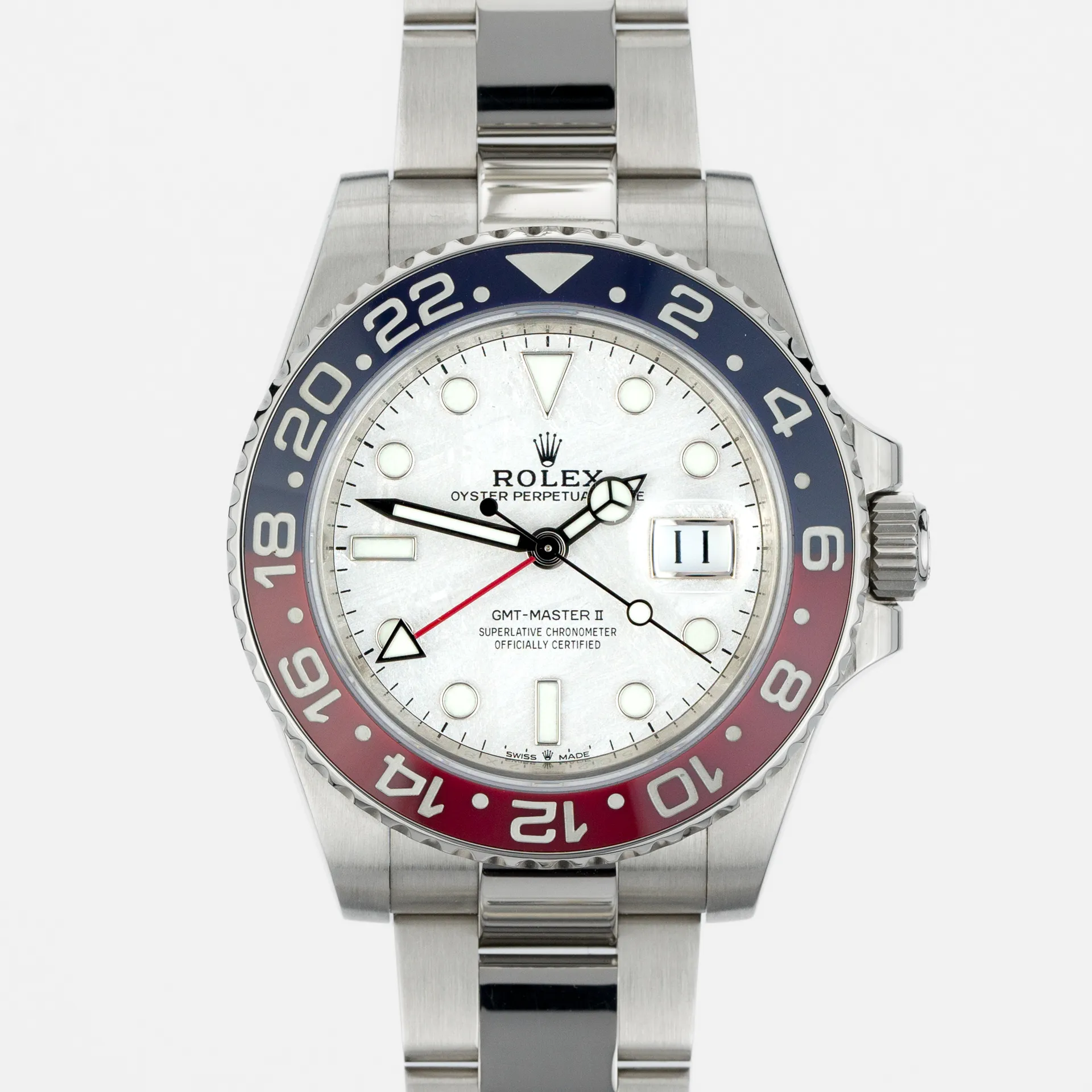
Today, for the first time, we have the pleasure of presenting to your attention the so-called “true Pepsi” – the model in 18-carat white gold with a blue dial on an Oyster bracelet made of white gold. This is one of the rarest Rolex models in general, offered in two versions – with this blue dial and with a meteorite dial – and it is produced in a very limited series. Today, we have the pleasure of offering to your attention for the first time the version with a meteorite dial, made from the Gibeon meteorite. It flew through the atmosphere and crashed to Earth in prehistoric times in what is now Namibia. It was first reported by Captain J. E. Alexander in 1836. The meteorite was discovered by the Nama people and used to make tools and weapons. Classified as an iron meteorite, it broke apart, scattering more than 26,000 kilograms of space debris over an area 275 km long and 100 km wide. To date, around 25 tonnes of fragments have been found. What is interesting is that practically all meteorite dials on the market today are made precisely from this meteorite.
The Gibeon meteorite probably originated as a piece of a planet’s molten core and travelled through space for millions of years. During its cosmic journey, the molten rock cooled, creating the unique patterns of crystallised iron and nickel technically known as “Widmanstätten patterns” or “Thomson structures” – named after two mineralogists who, at the beginning of the 19th century, discovered these remarkable crystal lattices.
Why, however, is this model so loved and sought after? One of the reasons is certainly its so-called “true GMT” – the new in-house Caliber 3285 movement, which has an increased power reserve of 70 hours and a seriously improved automatic winding system, in which the rotor is now mounted on a bearing and its efficiency has been increased by 15%. As for lubrication, the reversing wheels, one of the problematic areas from the point of view of friction, have a Teflon coating. The new 3285 contains 14 built-in patents and more than 90% new components, and in addition, it is twice as accurate as an official COSC chronometer. All of this allows the movement to be one of the few that fall into the brand’s “Superlative Chronometer” category.
We are sure that most colleagues reading this text are aware that Rolex call their water-resistant cases Oyster. In other words, when this name appears in the name of the watch, it means that it is water-resistant. And of course, the GMT-Master II meets this qualification 100% – although, unlike the Submariner, here this rating is only 100 m, but as you can imagine, these metres are real.
The dial of the watch is very balanced and “rich”, while the fact that, due to its origin, practically no two dials are the same makes every example unique in its own way. The luminescence of the hands and indexes makes it easier to use at night. It is blue in colour, which has been proven to be much more pleasant and harmless to the human eye, while Rolex’s so-called Chromalight allows the indexes to appear milky white during the day.
Although the GMT-Master II is a professional tool, as intended by the manufacturer from the very moment of its launch, it is clear to everyone that for quite some time it has become a luxury attribute – and for quite some time now, this function has prevailed over the original reason for its creation. Perhaps precisely for this reason, Rolex do many things in this model in such a way that the appearance and overall impression created by the watch prevail over its functionality. The first thing that makes an impression is the sapphire – Rolex apply the anti-reflective coating only on the inner side of the cyclops, which allows the outer part of the crystal to remain more brilliant and glossy to look at.
For the caseback of the watch, Rolex use a plain solid back, as they do in all their models – and in this case, it is devoid of any markings, inscriptions or other “decorations”. It is widely known that Rolex can be called fanatics when it comes to the alloys they use – a large part of the metallurgical processes are carried out in-house in order to guarantee consistent quality of the raw material. Many watches have passed through our hands, but we can say absolutely categorically that no other brand devotes so much attention and effort to the quality of the final product from the point of view of case finishing – and as a result, the outcome can only be unique quality and presence.
The overall impression is complemented by the 24-hour bezel of the watch – its purpose is clear: to track the second time zone – trivial, isn’t it? In the older models, the bezel insert was made of aluminium with printed hour markers, but with this model, in 2008, the ceramic bezel was introduced for the first time. Here again, the material is specially made and is different from commonly used materials, which is why Rolex call it “Cerachrom”. The bezel itself is divided into two segments – blue for the dark part of the day and red for the light part. It is precisely the colours that give the reference its BLRO abbreviation – BL from the French Bleu and RO from Rouge – while enthusiasts, because of this colour combination, gave the model the nickname “Pepsi”.
Truly, in the 1960s Rolex created a great product and invested the following 60 years in improving and perfecting it. If at the beginning it was valued by customers as a not very expensive everyday watch, today it is to a greater extent a fashion accessory, which nevertheless has all the qualities to become a long-term partner of its owner. Besides not letting you down, it will also not lose much of its value, because it is no secret to anyone that this brand not only cannot be found with large discounts when new, but also has the reputation of producing some of the watches that best retain their value. And this particular model can confidently be placed among the front ranks of Rolex in terms of popularity and, accordingly, among the most sought-after and desired models. One of the reasons for this is certainly the fact that this watch looks equally good on your wrist whether you are wearing a formal suit or worn jeans and a white T-shirt – in both cases, the GMT-Master II will help attract approving glances towards your appearance.