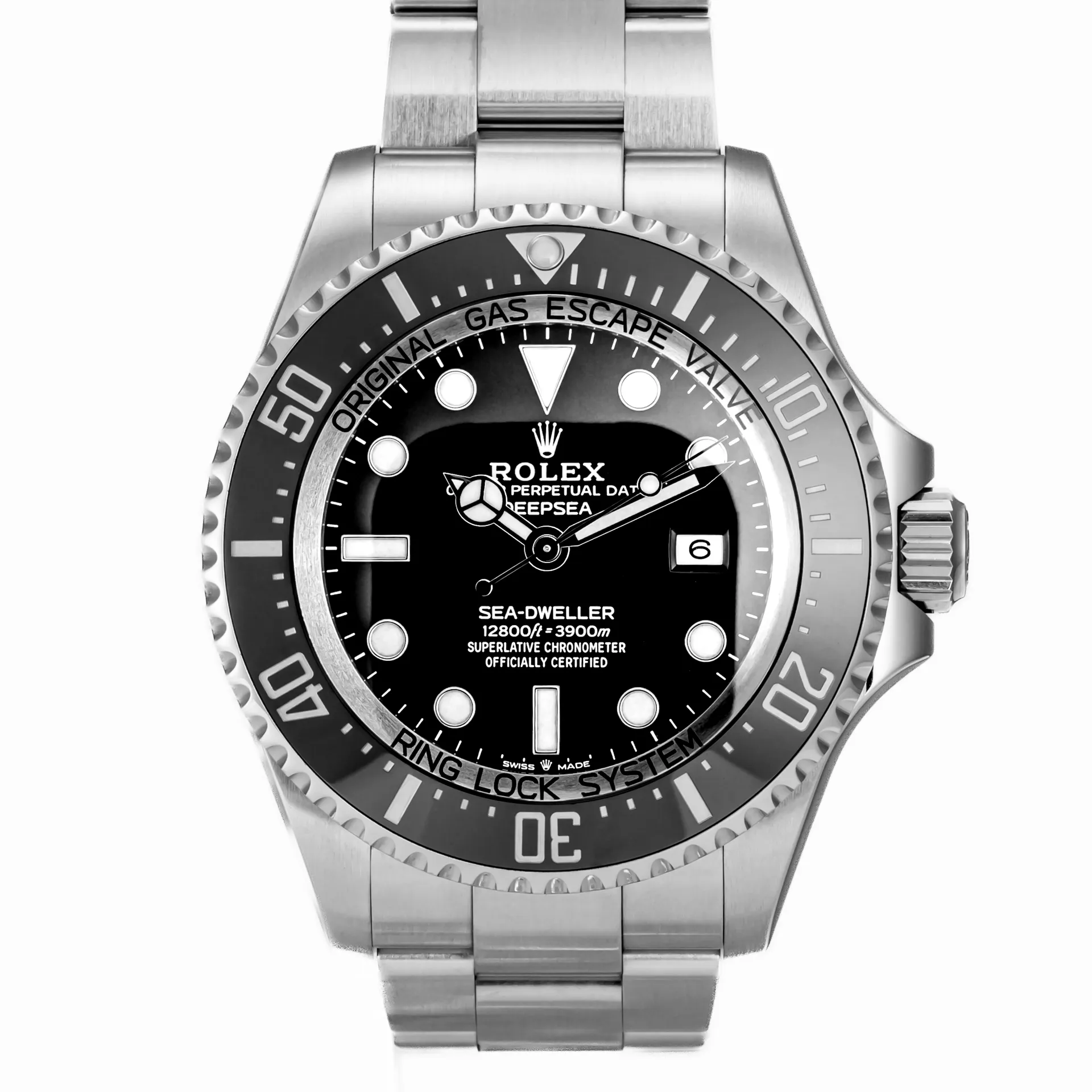
The Deepsea Sea-Dweller was first introduced at Baselworld in 2008, with its main purpose being to replace the hugely successful Sea-Dweller. From the moment it was presented, it strongly polarised the opinions of Rolex enthusiasts, particularly those devoted to the brand's diving watches. In fact, the situation went even further – because Rolex announced the discontinuation of the Sea-Dweller with the launch of the DSSD, many dealers placed considerably larger orders for the outgoing model, hoping to satisfy potential future demand (and, of course, to profit from any increase in its price). Subsequently, Rolex apparently reconsidered the decision and introduced the new Sea-Dweller 4000 in 2014, but that is another story.
The model presented today was launched in 2018 and belongs to the new generation of the brand's sports watches – featuring the latest calibres and a number of other innovations. We will discuss the differences between this version and its predecessor a little further down.
The DEEPSEA boasts water resistance of 12,800 feet (3,900 metres), an exceptional achievement for a watch of this category. Its inspiration comes from the legendary Deep Sea Special, developed by Rolex for the historic dive of 1960, when Jacques Piccard and Don Walsh descended to a depth of approximately 10,916 metres aboard the bathyscaphe Trieste! The experimental watch was attached to the outside of the vessel and successfully withstood the incredible pressure at that depth.
The DEEPSEA, or DSSD as this watch is also known, has an impressive diameter of 44 mm and a thickness of approximately 18 mm – you must agree that there are not many Rolex models that come close to this “giant” in terms of size. Like the original Sea-Dweller, it features a unidirectional rotating bezel with 60-minute graduations, has no Cyclops lens above the date and is equipped with a helium escape valve. The bezel features a black Cerachrom ceramic insert, resistant to scratches and corrosion, while the numerals and graduations are coated with a thin layer of platinum.
What truly distinguishes the DSSD from its predecessor, apart from its size, is, of course, the Ringlock system – a unique patented Rolex invention that allows this watch to withstand such extraordinary depths. The system consists of three main elements – a domed sapphire crystal approximately 5.5 mm thick, an exceptionally strong internal compression ring made from a special nitrogen-alloyed steel, and a caseback with a central component made from grade 5 titanium, retained by a steel ring.
To ensure the reliability of every watch of this model, Rolex invested in a special testing facility developed with the assistance of COMEX, and each DSSD is tested at a pressure exceeding its guaranteed water resistance by 25% – equivalent to a depth of approximately 4,875 metres, or almost 16,000 feet! The Ringlock system works in such a way that the enormous external pressure is absorbed by the special compression ring and the other structural components. The greater the depth, the greater the stress placed on the system, but it is precisely this design that allows the watch to withstand such extreme conditions.
In 2012, filmmaker James Cameron became the first person to reach the bottom of the Mariana Trench (Challenger Deep) alone – the deepest known part of the ocean. On 26 March, he reached a depth of approximately 10,908 metres, and Rolex proudly accompanied him on this historic journey. In this case, however, it was a specially developed experimental Rolex Deepsea Challenge, attached to the exterior of the submersible, rather than the production Deepsea. The experimental watch was designed to withstand depths of 12,000 metres!
In 2014, the documentary film about Cameron's historic descent to the bottom of the Mariana Trench, entitled “Deepsea Challenge”, was released, and Rolex commemorated this achievement by introducing a special version of the Deepsea – the D-Blue. Its dial gradually changes from deep blue to black, symbolising the gradual disappearance of light as one descends into the ocean depths. Interestingly, this version was not a numbered limited edition but part of the brand's regular collection.
The watch's dial is very clean and easy to read, while the luminescence of the hands and hour markers makes it practical to use even at night. The model belongs to the early generation of Rolex watches in which the brand introduced its characteristic blue Chromalight luminescence in place of traditional green luminous material. The material used by Rolex provides long-lasting blue illumination in low-light conditions, while the hour markers appear milky white during the day.
Rolex also use the so-called “Maxi Dial” style here, characteristic of the modern generations of the Submariner, GMT-Master II and Deepsea, with larger hands and hour markers – another reason why we like this model so much. The enlarged markers and hands contribute to excellent legibility, which is particularly important in a professional diving watch.
For the caseback, Rolex use a solid construction, as they do on almost all of their classic models. In the case of the DSSD, the central section is made from grade 5 titanium, while the surrounding steel ring secures it to the case. The watch proudly displays the inscriptions “ORIGINAL GAS ESCAPE VALVE” and “RING LOCK SYSTEM”, while the depth rating of “12800 ft = 3900 m” further emphasises the model's extraordinary technical capabilities.
As we all know, Rolex use high-grade 904L steel for their watches, which the brand calls Oystersteel. The main difference compared with the 316L steel commonly used by many other manufacturers lies in its chemical composition and greater resistance to certain types of corrosion, particularly in aggressive environments. It is widely known that Rolex can be described as fanatics when it comes to the steel they use – a large part of their metallurgical processes is carried out in-house to guarantee consistent quality of the raw material. Many watches have passed through our hands, but we can say with absolute confidence that few brands devote so much attention and effort to the quality of the finished product, especially when it comes to case finishing – and the result is inevitably an exceptional level of quality and wrist presence.
So, what exactly are the real differences between the new version and the previous one?
The first significant difference is the movement – the new Deepsea has the honour of housing Calibre 3235, replacing the Calibre 3135 used in the previous generation. The new movement offers an increased power reserve of 70 hours, compared with approximately 48 hours in its predecessor, a significantly improved automatic winding system with the rotor now mounted on a ball bearing, and the new Chronergy escapement, whose efficiency has been increased by approximately 15%.
A number of patented technical solutions have been incorporated, including the paramagnetic Parachrom hairspring and the Paraflex shock protection system. Calibre 3235 features automatic winding, 31 jewels and operates at 28,800 vibrations per hour. Furthermore, the watch is certified as a Superlative Chronometer, with an accuracy of −2/+2 seconds per day after the movement has been cased – a standard twice as strict in terms of maximum daily deviation as the traditional COSC chronometer certification.
The most visible difference, however, is the wider bracelet with its larger folding clasp. As a result of this change, the proportions feel more harmonious, since the lugs no longer appear to protrude so noticeably in relation to the bracelet. On the new reference 126660, the lug width has increased from 21 to 22 mm, while the lugs and end links have been redesigned so that the transition between the case and bracelet looks more natural.
The end links now fit much more harmoniously between the lugs – personally, we found it difficult to understand how Rolex had allowed such controversial proportions on the previous version. Overall, the bracelet has been redesigned to improve comfort and achieve better visual balance with the enormous case.
Rolex have also taken care of some of the smaller details – a small Rolex coronet positioned at 6 o'clock on the edge of the dial between the words “SWISS” and “MADE”, subtly revised hands and markers, and slight changes to the proportions of the case and bezel. At first glance, these may seem like minor differences, but it is precisely such details that demonstrate how carefully the brand approaches the evolution of its models.
For many years, the Sea-Dweller has been offered with a three-link stainless steel bracelet that tapers towards the clasp – and this model maintains the tradition, remaining just as comfortable in this respect. So where is the difference compared with previous generations? Mainly in the proportions and construction, since the Glidelock adjustment system was already present on the first-generation Deepsea.
The new DSSD is equipped with a substantial folding Oysterlock clasp featuring a micro-adjustment system called Glidelock. The idea is that you can adjust the bracelet without tools, in increments of approximately 2 mm and over a total range of around 20 mm. We all know that our wrists change size depending on the weather, humidity, temperature and so on – well, the guys at Rolex have come up with the ideal solution for such situations.
The fact that the clasp is also equipped with the additional Fliplock extension, allowing the bracelet to be lengthened by approximately another 26 mm, makes it even more functional, particularly when worn over a diving suit. It is important to know that the Glidelock system is also available on other professional Rolex diving models, including the Submariner, but on the Deepsea its combination with Fliplock is particularly suitable for the watch's extreme intended purpose.
Another detail that absolutely deserves mentioning is the clas