As we all know, there are watches that are classified in the “Diver” category, but there are also those for which a separate “Driver” category has been created, and the undisputed flagship of this category is precisely the Daytona. In principle, the original name of the model was Cosmograph, and it received its nickname “Daytona” in the late 1960s after many years of sponsorship in motorsports and in honor of the Daytona International Speedway.
It is a known fact that Rolex is the largest manufacturer of luxury watches with a production of over a million pieces each year, but regardless of this fact, it is a brand that not only best retains its value over time, but also has some models that are almost impossible to simply buy in a distributor's store. The hardest to find, and those for which there are long waiting lists, is precisely the Daytona – in the steel version, regardless of whether it has a white or black dial. The reason for this is not only the cult status that the model has earned over all these years, but also the fact that Rolex sends a limited number of steel Daytonas to each of its dealers, and they, in turn, are forced to create lists of waiting customers and/or to select which of them to "delight". All of this leads to the situation we find ourselves in today – on the secondary market, Daytonas are offered at about 80-100% more than the retail price!
Undoubtedly, the Daytona long ago became a fashion accessory (and even a status symbol), but the watch incorporates specific functions that aim to pursue its original purpose – that of a true “driver”. Measuring and calculating time, average and instantaneous speed through the use of the chronograph and the tachy-scale – all these functionalities aim to assist every owner of the watch in their sporting activities, and the 40-millimeter Oyster case (when this name is present in the name of a Rolex, you can confidently get it wet) and the Triplock crown provide the sufficient water resistance of 100 m for marine adventures.
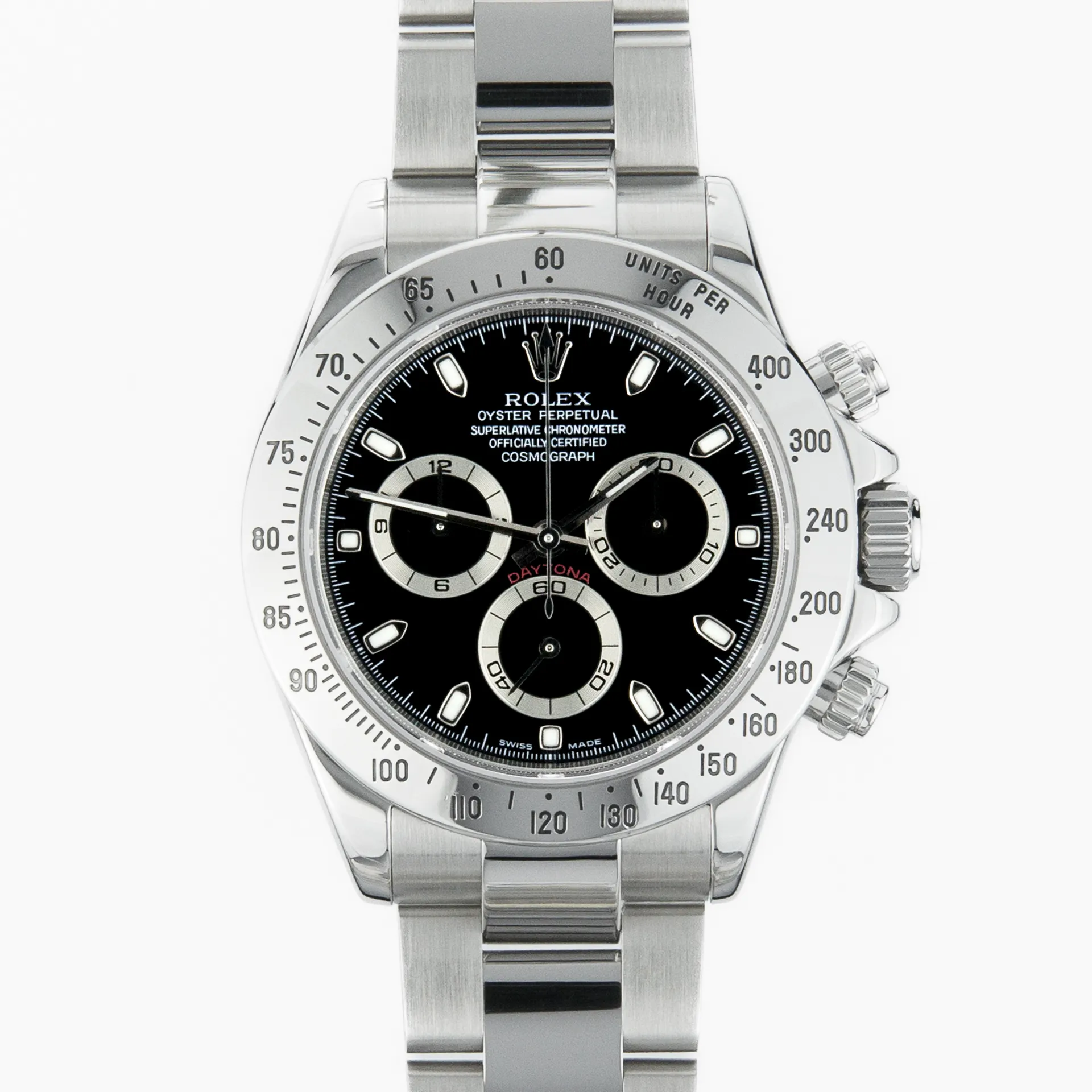
The specific watch is a 2006 model and besides being one of the first with cases featuring so-called "non-drilled" lugs, it also has the new-type clasp – in this combination, the model was offered almost unchanged until the launch of the new Daytona with a ceramic bezel. This is the version with the black dial, which is undoubtedly the most iconic for the model, the most sought-after and most desired, and in my humble opinion, it is also the most balanced not only in comparison with the different versions of the bi-color variant, but also in comparison with the white Daytona.
The Daytona is neither the most expensive, the most robust, the most complicated, nor the most beautiful “Driver” – why then is it so desired, valued, and successful? Surely one of the reasons lies in its now-famous in-house movement, Caliber 4130, which has a reputation for being robust, accurate, durable, and easy to service. The movement's faithful "service" to the fame and honor of Rolex began in 2000 (let me just remind you that with this movement, Rolex replaced the Zenith El Primero, which had been used for decades for this model!) and in these now 18 years, it has earned the reputation of being one of the most reliable and robust chronographs ever. An automatic chronograph with a column wheel, hacking function, operating at 28,800 vibrations, with 44 jewels, 201 parts, and a power reserve of over 72 hours, and of course, we cannot go without some of Rolex's patents – in this case, the Paraflex anti-shock system and the Parachrom hairspring.
The watch's dial is very balanced and easily legible despite the many functions, and the luminescence of the hands and indices facilitates its use at night – it is a pleasant greenish color and glows brightly and for a long time.
Regardless of the fact that the Daytona is a professional instrument, as was the manufacturer's intention from its very launch, it is clear to everyone that for a long time it has become a luxury attribute – and for some time now, this function has prevailed over the original reason for its creation. Perhaps for this very reason, Rolex does many things in this model so that the appearance and the overall impression the watch creates prevail over its functionality. The first thing that makes an impression is the sapphire crystal – Rolex is notorious for the fact that they do not apply anti-reflective coating to the crystals of their watches – there are several versions for the reasons, but I most like the one that Rolex does it so that the appearance of their watches does not change for a long time and generations of its owners can enjoy this consistency. The second, of course, is the fact that the manufacturer managed to create an icon more than 50 years ago, and through all these years and different models, the design has hardly changed – another proof of the timelessness of classic designs.
For the case back of the watch, Rolex uses a simple solid case back (as, by the way, in all its models) – in the case of the Daytona, it is devoid of any markings, inscriptions, or other "decorations". As we all know, for its watches, Rolex uses 904L steel – the difference with the usual 316L for other brands is in the greater resistance (especially against salt water). It is a widely known fact that Rolex can be called fanatics when it comes to the metals they use – a large part of the metallurgical processes are done in-house to guarantee a consistent quality of the raw material – many watches have passed through our hands, but I can say with absolute certainty that no other brand devotes so much attention and effort to the quality of the final product in terms of the finish of the cases – and as a result, a unique quality and presence cannot but be achieved.
The overall impression is complemented by the watch's tachymetric bezel – its purpose is clear, to help in calculating average speed, speed of movement, and other important quantities for motor sports.
For many years, the Daytona was offered with a three-piece steel bracelet with a profile that tapers towards the clasp – in this model, the tradition is respected, and from this point of view, the bracelet is just as comfortable, and the clasp deserves separate attention. The model presented today is the first in which Rolex used a clasp machined from a solid block of steel (and not from bent sheet metal as in previous models) – subsequently, this clasp and its variations were implemented in most other Rolex models.
Indeed, in the 1960s, Rolex created a great product and invested the next 50 years to improve and perfect it. If at the beginning it was appreciated by customers as a not-very-expensive specialized watch primarily for motorsports, today it is to a greater extent a fashion accessory, which, however, has all the qualities to become a long-term partner to its owner, who will not only not let you down, but will also not lose much of its value, because it is no secret to anyone here that this brand, besides not being found with large discounts when new, also has the reputation of being the brand with the best value retention for its timepieces, and this particular model can boldly be ranked at the forefront of Rolex in terms of popularity and is accordingly one of the most sought-after and desired models. Surely one of the reasons for this is the fact that this watch looks equally good on your wrist whether you are in a formal suit or dressed in worn-out jeans and a white t-shirt – in both cases, the Daytona will help attract approving glances to your appearance. And the fact that the watch is in a rare condition for its age makes it a truly great opportunity to acquire an iconic representative of the brand, which is desired by many connoisseurs, without having to wait several years on dealer lists.