IWC.
There is hardly anyone among the lovers of the art of watchmaking for whom these 3 letters mean nothing. The brand, founded in 1868 by American engineer and watchmaker Florentine Ariosto Jones in Switzerland, with the goal of producing high-quality watches for the American market, managed, acquired in 1880 by the Rauschenbach family, owned and managed by 4 generations of the family until 1955. The brand that was one of the first (as early as the end of the 19th Century) to begin producing wristwatches. The undisputed founder of the so-called “pilot's watches”, the first to use titanium for the cases of its chronographs and to produce unique works of horological art such as the representatives of the Portuguese and Ingenieur series.
The birth of the “Portuguese”
Undoubtedly, in the 15th and 16th centuries, Portugal was one of the cradles of sea travelers and explorers - the names of Vasco da Gama, Ferdinand Magellan, and Bartolomeu Dias are permanently inscribed in history, and thanks to their consistency and spirit of discovery, many of the New Lands enjoy the blessings of civilization (for better or for worse). And since in those times even the bravest dreamers among them could not have imagined that there could be a device with GPS functions (in fact, at that time even relatively accurate maps were more of an exception), sailors had to rely on their own knowledge, expertise, and to a large extent intuition, using the position of the stars and a few primitive instruments, such as the astrolabe, sextant, and a little later, the first marine chronographs.
All this continued until the moment when two businessmen from Portugal visited the IWC manufacture to order a special chronograph – their desire was for a large and rather inconvenient instrument to be changed to the size of a wristwatch, but at the same time to retain the precision of a chronometer. This is the story of the appearance of the first improvised "Portugueuse" in 1939, as well as the explanation for its name. With its huge (by the standards of the time) 43 mm case, simple and clear dial, and a pocket watch movement, it provoked many mixed reactions and comments, but more importantly - it gave birth to one of the most recognizable watch collections in the world.
Currently, the Portuguese line includes 13 models, starting from the simplest manual winding model (the closest to the original) through the 7-day automatic (I have the pleasure of owning one), perpetual calendar, tourbillon, repeater, to the most complicated watch in the history of the manufacture, the Siderale Scafusia.
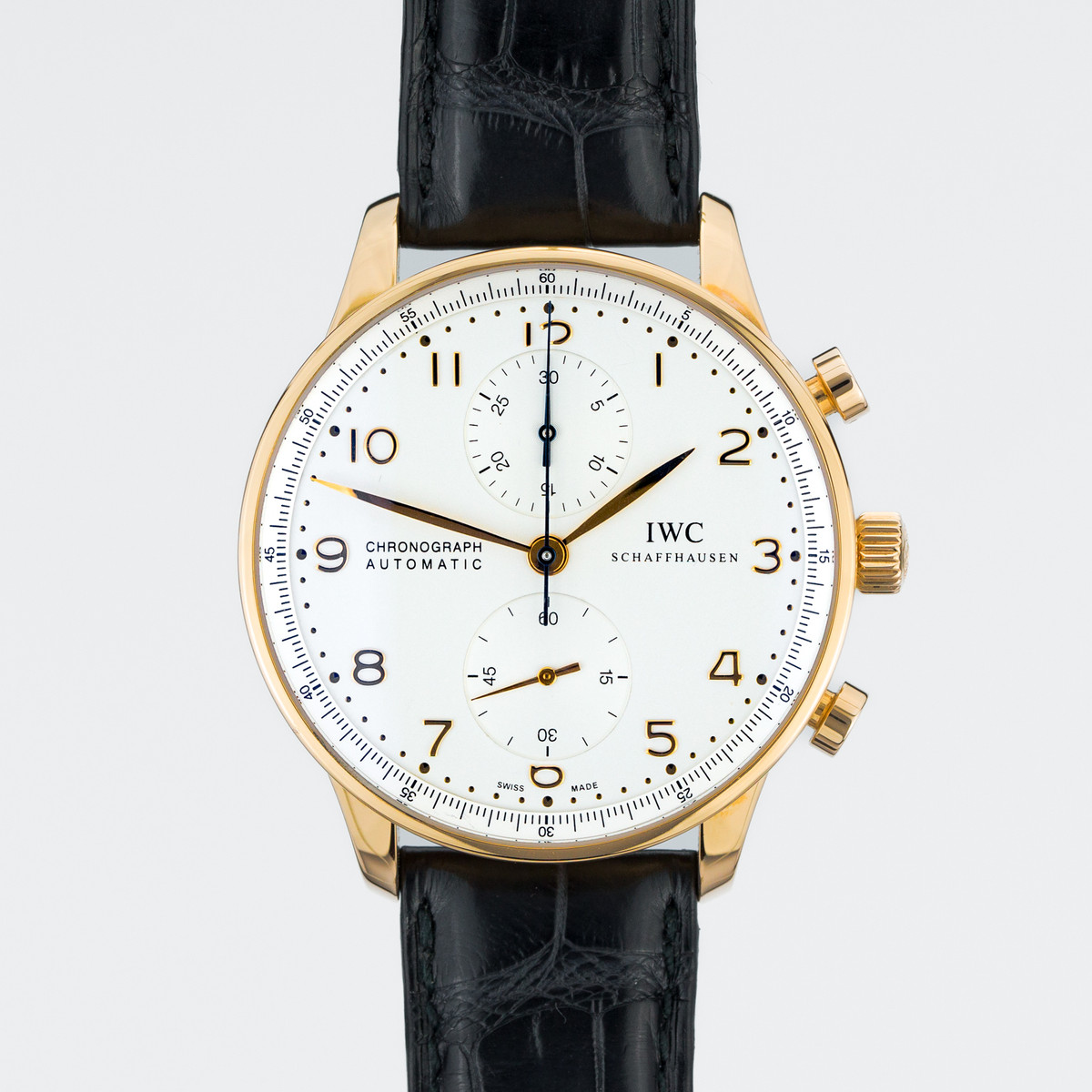
Of course, there are also several chronographs – and we want to focus on the most popular model in the company's entire portfolio, namely the IWC Portuguese Chronograph Rose gold IW371480
The original chronograph in the series is a direct successor to the classic model of the most popular contemporary IWC model. With its simplified and modest design, with a very clear, almost minimalist dial without a date indicator, a not-so-large case (40.9 mm), the well-proven over time and in many different models of all kinds of brands Valjoux 7750 movement, and a moderate price (compared to direct competitors) it turned out to be the golden recipe for success. This watch has even appeared on the big screen many times - Jamie Foxx with his 3714 with the "panda dial" version in the "Miami Vice" remake and the demonic Francis Underwood (Kevin Spacey) with the silver dial version in the series "House of Cards" are perhaps the most iconic on-screen partners of the 3714. Today's offering, however, is very different – not least because this is the version in an 18-carat rose gold case.
One cannot remain indifferent to this watch – the simplicity of the design, combined with elegance, the seemingly small size by today's standards makes a completely different impression in person thanks to the practical absence of a bezel, and the gold hands and hour markers not only add a large dose of aristocracy, but are also a wonderful finishing touch to the whole combination with the gold case. As for the wearing comfort – this is certainly one of the watches that can boldly compete for the top spots in such a ranking – with its mere 12.3 mm thickness, the case sits very snugly on your wrist and surely becomes a great addition to a fine suit of at least 160 S wool, and why not a tuxedo.
The model is the most expensive of all the 3714 modifications and is the most pursued and sought-after by collectors and enthusiasts.