Rolex Yacht-Master II All Gold 116688 | Chronoteka
1 of 9
Image 1 of 9: Yacht-Master II All Gold - Image 1
Share this watch
Why Choose Chronoteka
Authenticity Guaranteed
Every watch is verified by our expert team
12-Month Warranty
Peace of Mind
Expert Support
Professional guidance throughout your purchase
Rolex Yacht-Master II All Gold
Reference: 116688
€33,999.00
Year
2008
Condition
Very Good
Set
Full Set
Specifications
MovementAutomatic
Case Materialyellow gold
Case Size44mm
Power Reserve72 hours
Dial ColorWhite
Complications & Features
ChronographSmall secondsLuminous handsChronometerRotating BezelScrew-Down CrownLuminous indices
Description
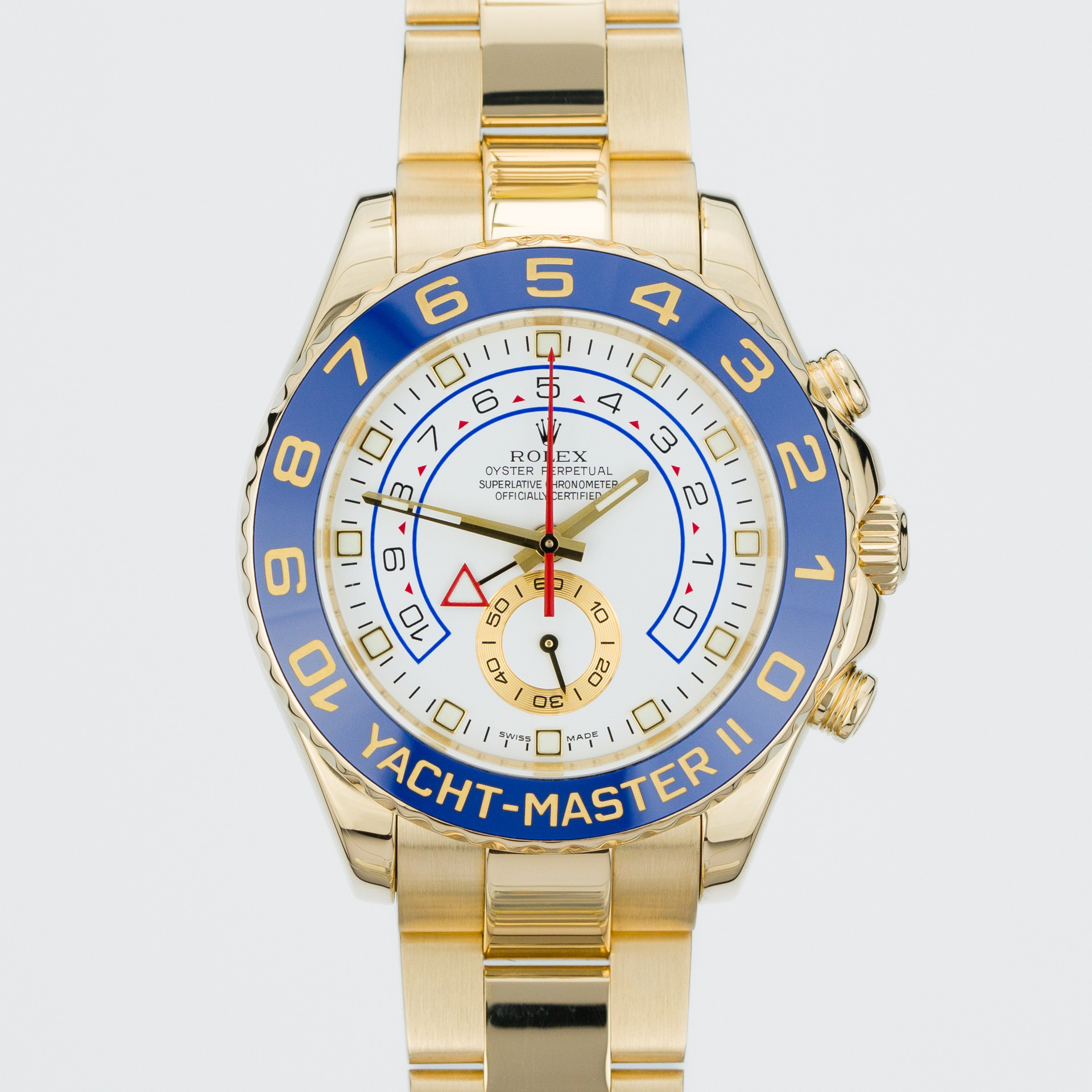
For the first time, we have the opportunity to present to your attention the most expensive version of one of the most interesting and unique Rolex models – the Yacht-Master II.
As most of you reading these lines know, this Rolex series offers a very interesting and complex function – the regatta timer.
The regatta timer is used by the yacht's skipper to determine the most precise moment for his boat to cross the starting line. As you can imagine, unlike the cars in Formula 1 or the motorcycles in MotoGP, participants in regattas cannot remain anchored at the starting line, and for this reason, the race committee establishes a countdown period during which the boats must move around the starting line without actually crossing it: if you cross too early, there is a penalty, and if you are too cautious and cross later, you will give your competitors an advantage right at the start of the race. Different regattas have adopted different intervals, but they are all 5, 7, or 10 minutes – meaning this watch can serve you in any of these regattas.
The Yacht-Master II is a programmable regatta timer with a flyback function that allows you to select a countdown interval from one to ten minutes; furthermore, if you have started the countdown earlier or later than necessary, you can synchronize your watch 'on the fly' when you hear the second of the two audible signals (usually a cannon shot) that are given before the start of the race (first is the signal to start the countdown, which is followed by a second warning signal closer to the start). To set the countdown timer, turn the bezel (Rolex calls it the 'Command bezel') a quarter turn to the left. This locks the lower chronograph pusher and engages the setting mechanism for the countdown hand with the red triangular tip. Then, you unscrew the crown to the first position and adjust the countdown hand – the adjustment is unidirectional only, but after the 10th marker, if you continue to turn the crown, the countdown hand will jump back to '1' and you can continue until you reach the desired countdown period. When you are finished, screw the crown back in and turn the bezel back to its home position.
When you hear the first shot, you press the pusher and start the countdown.
And now let us turn your attention to a truly unique functionality for a mechanical watch – in case you have started the countdown too early or too late for some reason (you missed the signal because your hands were busy with the 'education' of a young female cabin boy, or at that exact moment the NASDAQ suddenly dropped by 15% and you had to react…) – do not worry, everything is correctable (unlike the incident with the cabin boy – especially if there is a 'well-wisher' in the crew who happened to film everything and send it to your wife…). Wait for the second signal and press the reset pusher – the red seconds hand will fly back to the zero mark and immediately start a new countdown, and the minute countdown hand will move to the nearest minute marker and also begin to count down again. The fact that it resets to the nearest minute, and not to zero, allows you to synchronize your countdown with the official time.
We are sure that this is a very useful functionality, but we suspect that 90% of the watch's owners will not make use of it. However, it is possible to find another purpose for it – for example, to set it for 7 minutes after your pelmeni have floated to the surface of the water, so you will get a signal when they are ready. Or if it so happens that the cabin boy from the yacht also happens to double as your personal assistant, it is possible to measure the exact 10 minutes of the break between two important meetings and calmly 'release the tension' without worrying that your puritanical partners will witness the sacred act…
One thing is certain – owning this model will unleash its owner's imagination and drastically increase their ingenuity!
But let's stop discussing its functions and talk about the model's aesthetic message. At 44 mm, it is not only one of Rolex's largest models, but perhaps its most extroverted – and not just because of its size. The bright blue bezel (for which the well-known Cerachrom is used) was not enough, and to leave no doubt as to which exact model is on your wrist, the manufacturer has indicated it with large letters: YACHT-MASTER II. The abundant use of yellow gold in the watch's design adds a large dose of aristocracy to the model's presence and 'adds value'. But, leaving this extroversion aside, the watch is truly comfortable to wear – unlike the DSSD, the other giant in the Rolex line-up – it is more compact, thinner and lighter, more elegant and very attractive. Indeed, once you get used to its size, you will understand what we are talking about. The sharply contrasting hands, white dial, and red countdown hand – and, yes, that bright blue bezel – give the entire timepiece a unique maritime feel and make it a pleasure to look at (and thanks to the abundant luminescence, visibility is very good at night as well), while the numerous yellow gold elements decidedly attract admiring glances, not only from the fairer sex, but certainly also from connoisseurs of the horological art.
Yes, this is an extroverted watch, but the quality of execution is very clean and of a very high level (as can usually be expected from Rolex) and contrary to the initial impression, this is not a specialized instrument for a narrow group of professional yachtsmen, as this same skipper, after finishing his work on the Board of Directors and dismissing the cabin boy, can calmly put on a pair of ripped jeans and a white t-shirt and ride his old Indian on the way to some Woodstock or other rock festival... And his blue friend will worthily accompany him everywhere...
For the case back of the watch, Rolex uses a simple solid case back (as, by the way, in all of its models) – in this case, it is devoid of any markings, inscriptions, or other 'decorations'. It is a widely known fact that Rolex can be called fanatics when it comes to the alloys they use – a large part of the metallurgical processes are done in-house to guarantee a uniform quality of the raw material – many watches have passed through our hands, but we can say with absolute certainty that no other brand devotes so much attention and effort to the quality of the final product in terms of the case finishing – and as a result, a unique quality and presence is invariably achieved.
As we have already mentioned, a three-piece solid-link bracelet is used here, with a profile that tapers towards the clasp – this makes the bracelet very comfortable, and the clasp is an Oysterlock with a safety catch, micro-adjustment capability, and Easylink.