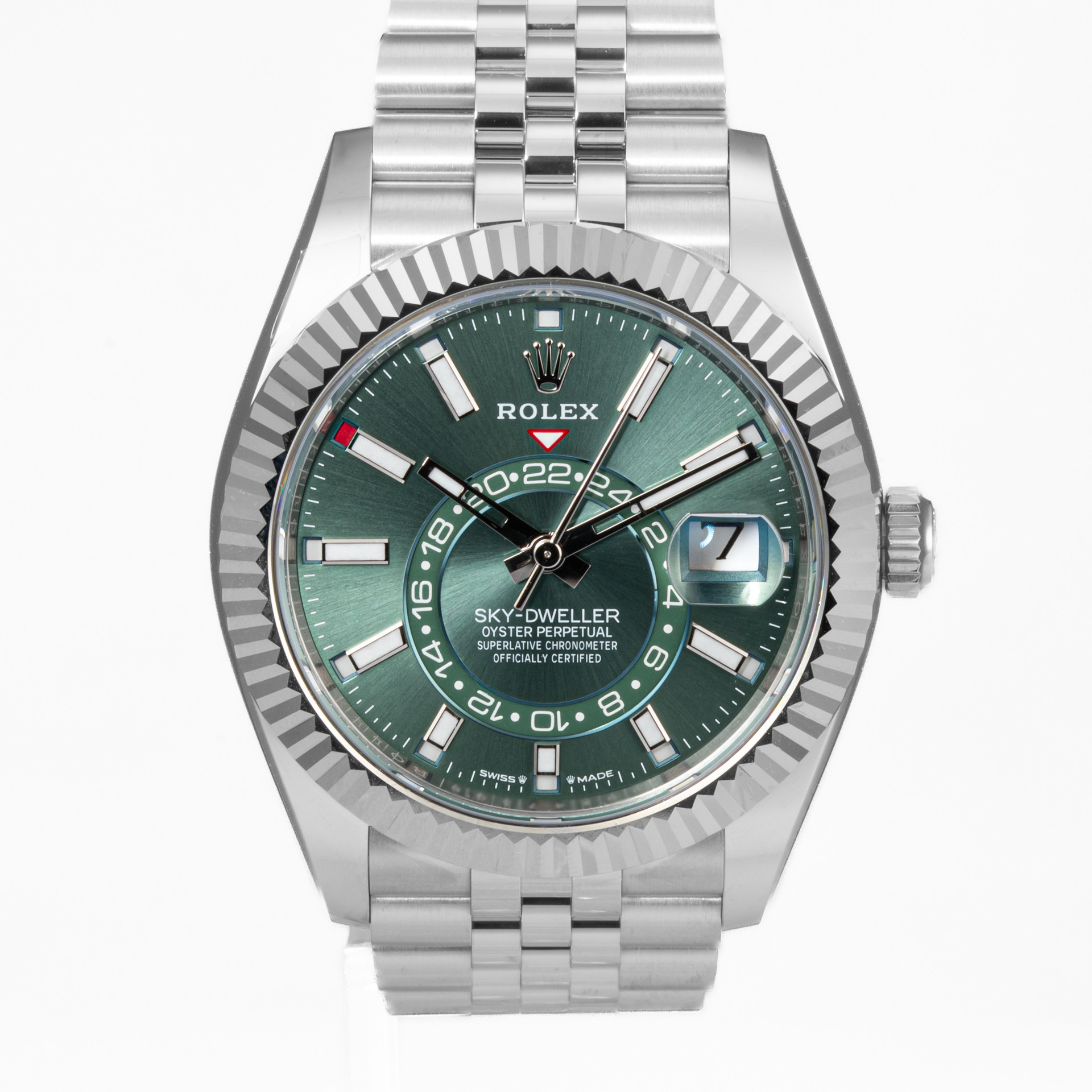
The current Rolex Sky-Dweller was introduced in 2023 and represents the new iteration of the first model in the series, which was introduced in 2012. It aims to silence all the brand's detractors who constantly mock the "new models" – that there is no difference from the previous ones, that they introduce practically no technological innovations, that they use 50-year-old movements, etc., etc. The mouths of all such "commentators" and "connoisseurs" are once again silenced, because the product is truly impressive. The size is different, the functionality is truly impressive, the dial design is different from anything known so far, and the movement…. In fact, that is where the big surprise lies… The main source of pride is precisely Calibre 9002, which was developed exclusively for the Sky-Dweller. Like all Rolex Perpetual calibres, it uses the common architecture for bidirectional self-winding via the Perpetual rotor, Paraflex shock protection, and a Parachrom hairspring. Here, however, the automatic winding system has been seriously improved, with the rotor now on a ball bearing, and efficiency increased by 15%. As for lubrication, the reverser wheels, as one of the problematic areas in terms of friction, are Teflon-coated – as a result of all this, the power reserve is increased to an impressive 72 hours!!! To this day, this remains the most complex calibre ever created by Rolex! All these characteristics are inherited from the previous calibre 9001 – the differences in the new one are mainly two: the patented Chronergy escapement and the skeletonized rotor.
Truly, the detail of this timepiece (as with all modern Rolexes we have had the opportunity to examine) is impressive. A detailed look reveals the exquisite craftsmanship, and the overall impression is very aristocratic. Starting with the incredible dial (in the watch presented, it is the Mint Green dial, rarely used by the brand on a small number of models). Moving on to the classic sapphire with a "Cyclops" lens – in this case, the brand's highest grade of sapphire was used, which has allowed the overall height of the watch to be reduced compared to its predecessors. Of course, separate attention must be paid to the case and the bezel – an incredible combination of polished highest-grade 904 L steel with faceted polished edges and details in places (as you know, Rolex pays special attention to the steel used and for this purpose has its own foundries for the production of all its alloys) with a Rolesor bezel. The brand's characteristic "fluted" style, which gives an incredible presence, and the fact that the bezel is made of 18-carat gold further reinforces the overall impression! Unlike all other models of the brand that use this bezel, in this case, it is functional!
Sky-Dweller displays two time zones simultaneously - the local time and date are in the standard Rolex format, and on a separate sub-dial is a 24-hour disc, with the hour indicated by a fixed inverted triangle. The 24-hour scale makes it easy to distinguish between day and night, and the month is displayed through one of the 12 apertures located around the hour indices.
Adjusting so many indicators usually requires remembering several crown settings, or several additional pushers, or those hidden small correctors for which you have to use that special tool that the dealer gave you separately with the explicit mention "do not lose it under any circumstances, or else...". However, this is not the case here – yes, here too you use the crown for quick setting of all functions, but here it does not work in the usual way. Instead, you first select the function you want the crown to perform.
The Sky-Dweller uses an intelligent bezel technology known as the "Ring Command" – it is similar to the one used in the Yacht-Master II. Rotating the bezel interacts with the movement, thus selecting which function is activated by turning the crown. This complex mechanical module includes over 60 components, and it can be operated by turning the bezel in both directions.
Before the Sky-Dweller, Rolex only offered the so-called "complete calendar," which, although similar, does not take into account the different lengths of the months - Rolex solved this problem by introducing four additional gear wheels. Thus, the simple but ingenious annual calendar system called SAROS was created. "Saros" is a Greek term - it means the astronomical cycle governing the recurrence of an eclipse. The design is inspired by the cyclical alignment of the Sun, Earth, and Moon - hence the name.
A satellite (earth) wheel engages a fixed planetary (sun) gear wheel over the course of a month, driven by the date disc. The "Earth" in turn has its own satellite (moon) wheel, equipped with four fingers for each of the four 30-day months. At the end of these months, one of the fingers causes the date disc to "jump" two days in a few milliseconds. Therefore, the 31st date is "eclipsed". Because of this, manual intervention is only required on March 1st.