When the first Rolex Datejust was introduced in 1945 – the year of the brand's 40th anniversary, it made history as the first automatic waterproof certified chronometer with a date on the dial. The 'Cyclops' was added in 1955 to magnify the date display by two and a half times, thus making the indication more legible and clear, and this feature became one of the most recognizable hallmarks of Rolex altogether.
In 2009, Rolex introduced the Rolex Datejust II. This line of watches offers the features of the original and iconic Rolex Datejust in a simpler and more modern design and includes new innovations. One of the most significant differences between the Rolex Datejust and the Rolex Datejust II is, of course, the size – the new one is 41 mm, significantly larger and follows the new trends for larger watch cases. The other difference is the movement – the Datejust II has the honor of carrying within it, made by the brand exclusively for this model, caliber 3136 – an in-house movement with Paraflex anti-shock protection, a Parachrom hairspring, a COSC certified chronometer with a 48-hour power reserve, operating at 28,800 vibrations per hour.
In 2017, the brand also introduced the newest version of the model under reference 126300. One of the biggest changes is precisely the movement – the new caliber 3235, which has an increased power reserve of 70 hours, a seriously improved automatic winding system where the rotor is now on a ball bearing, and its efficiency is increased by 15%. As for the lubrication, the reversing wheels, as one of the problematic areas in terms of friction, are Teflon-coated! The new 3235 has 14 integrated patents and more than 90% new components, and furthermore, it is twice as precise as the official COSC chronometer.
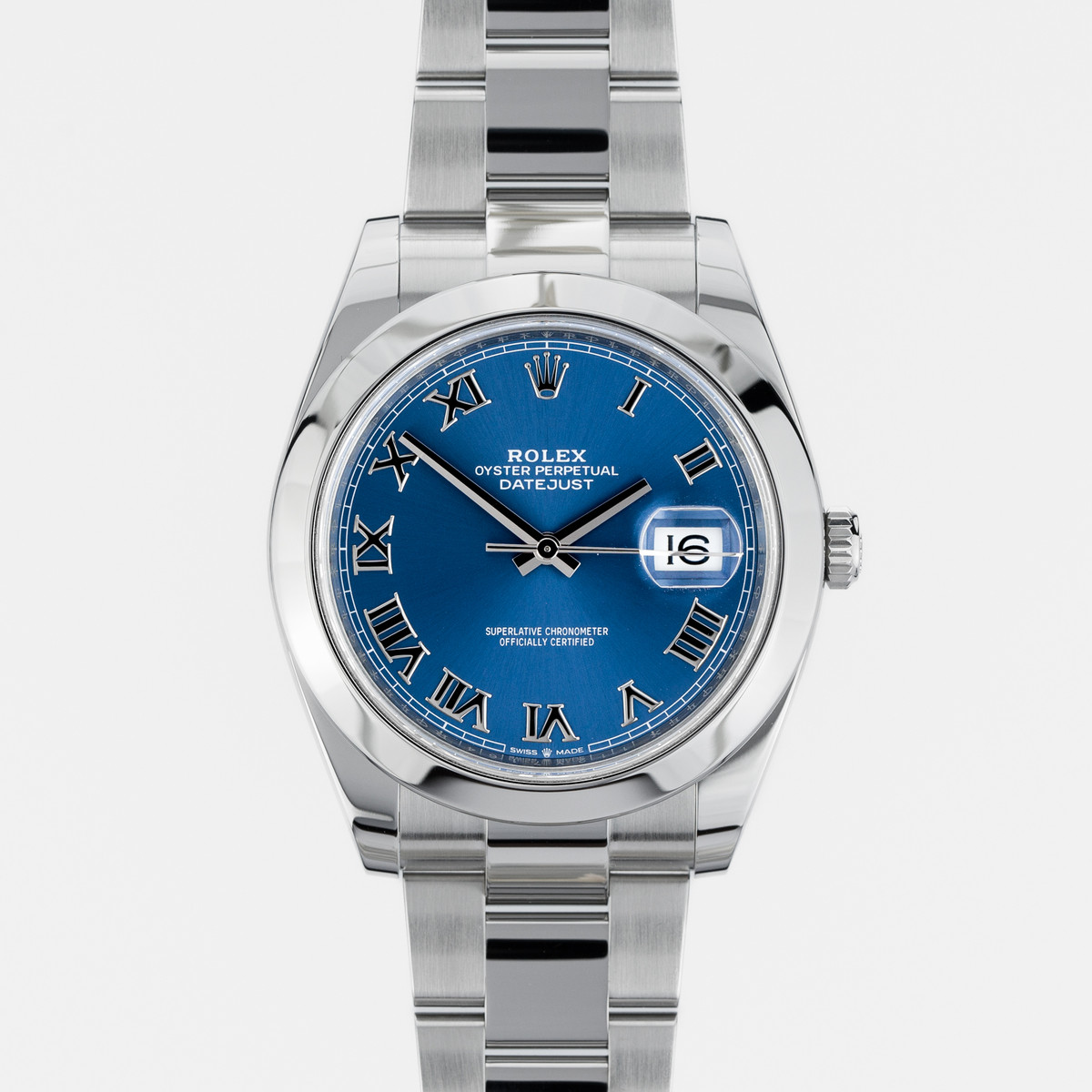
Not for nothing, the Datejust is the brand's most popular and recognizable model after the iconic Submariner – and the Datejust II allows this popularity to be presented in a contemporary interpretation. The specific watch is in the great and relatively hard-to-find combination – a light blue dial with gold Roman numerals for the hours. It is precisely these numerals that are the reason this model found its place in the series of 'special' Rolex models – those that, thanks to their specific features, receive nicknames – this particular one gets the name “Azzuro Blue” because of the light shade of the blue color. As with the other models with nicknames, this one is also very difficult to find, it is practically impossible to order it from authorized dealers, and it is highly sought after by all fans of the brand.
Indeed, the detail of this watch (as, by the way, with all modern Rolexes we have had the opportunity to examine) is impressive. A detailed inspection reveals the jewel-like craftsmanship, and the overall impression is very aristocratic. Starting with the incredible dial with the luminescent coating in the brand-specific Chromalight (which in this case is on the hour markers and the hands). Moving on to the incredible sapphire with the 'cyclops' – the brand's highest grade of sapphire is used, which has allowed the overall height of the watch to be reduced compared to its predecessors. Of course, separate attention must be paid to the case and the bezel – an incredible combination of brushed steel of the highest grade 904L with solid 18-carat white gold (as you know, Rolex pays special attention to the steel used and for this purpose has its own foundries for the production of all its alloys).
The bezel is the so-called 'smooth' type, which gives an incredible radiance and has an elegant presence on your wrist. And of course, the bracelet, the band, the chain, or whatever you may call it – as can be expected from a Rolex it is truly good… In this case, it is the new Oyster bracelet with a solid clasp, crafted from a single block of steel (and not from bent sheet metal, as is the case with most brands) – the only thing it lacks (but only according to some people) is the GlideLock clasp of the Sub, but here it is fitted with the so-called EasyLink which allows for micro-adjustment with an additional 5 mm.