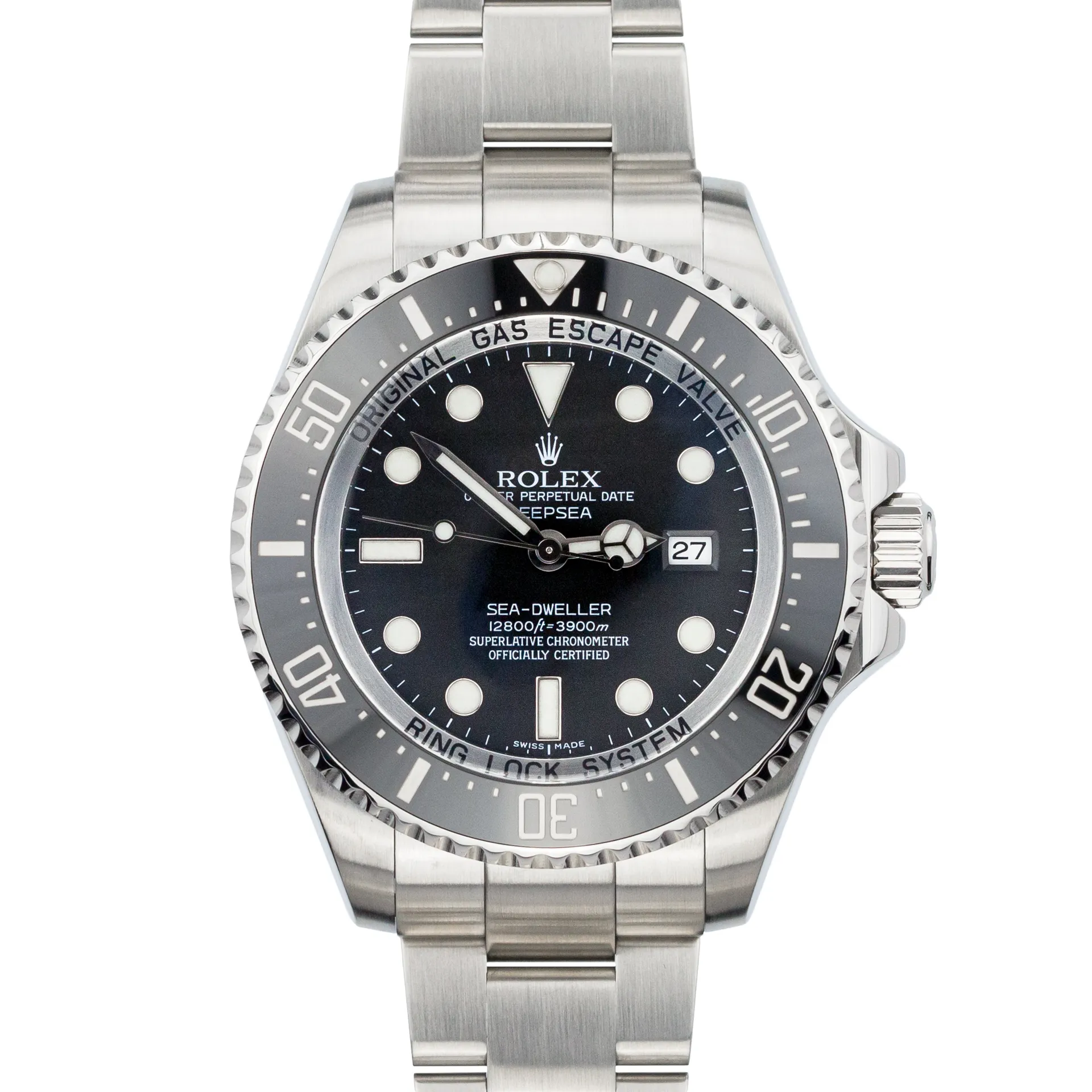
The model was first introduced at Baselworld in 2008, with its main purpose being to replace the super-successful Sea-Dweller. From its very introduction, it greatly polarized the opinions of the brand's enthusiasts and of "divers" in particular, even more so – because with the launch of the DSSD, the brand announced it was discontinuing the Sea-Dweller, most Rolex dealers placed much larger orders for this model (some several times larger) with the idea of meeting its potential future demand (and of course to profit from its increasing price). Subsequently, Rolex realized that discontinuing the model was a mistake and in 2014 launched the new Sea-Dweller 4000, but that is another story...
The DEEPSEA has a water resistance of 12,800 feet, unique for a watch of this class, and the inspiration for this model is the legendary Deep Sea Special, produced by Rolex back in 1960 to accompany some brave men who dared to reach the previously unattainable 10,916 meters! The DEEPSEA or DSSD (as this watch is also known) has an impressive diameter of 44 mm and a thickness of 17.7 mm – you must agree there are not many Rolex models that approach this "giant" in size. Like the original Sea-Dweller, this one also has a unidirectional rotating bezel with 60-minute graduations, no "Cyclops" on the date, and features a helium escape valve. The thing that truly distinguishes the DSSD from its predecessor, besides the size, is of course the Ringlock System – a unique Rolex invention that allows this watch to reach such depths. This system consists of a 5-millimeter thick sapphire crystal, a steel ring in the middle, and a grade 5 titanium case back. To ensure a 100-percent guarantee for the water resistance of all watches of this model, Rolex invested in a special facility, constructed with the help of COMEX, and tests every DSSD at a pressure equivalent to a water column of 16,000 feet – 25% above the guaranteed rating!!! The Ringlock System in fact "closes" ever more and tighter as the pressure increases. In 2012, director James Cameron became the first solo diver to reach the bottom of the Mariana Trench (Challenger Deep), the deepest part of the ocean, and a Rolex Deepsea proudly accompanied Cameron on this historic journey. As a result, and to commemorate this historic event, Rolex began production of a special DSSD, called the Deepsea D-Blue, with a deep blue dial and the "DEEPSEA" inscription in green, which has become one of the most sought-after and value-retaining watches on the secondary market (at least for now).
The watch's dial is very clean and easily legible, and the luminescence on the hands and indices facilitates its use at night. This particular model is one of the first in which Rolex replaced the green color of the luminescence with blue (which is proven to be much more pleasant and harmless to the human eye) – and the so-called Chromalight used by Rolex allows the indices to appear milky white during the day. Here, Rolex also uses the so-called "Maxi dial" style, which was launched with this very model along with the GMT II, and with which the manufacturer increases the size of the hands and markers – another one of the reasons I really like this model.
For the watch's case back, Rolex uses a simple solid case back (as, by the way, in all its models) – in the case of the DSSD, it is made of titanium, and on its polished outer ring, it proudly bears the full model name "ROLEX OYSTER DEEPSEA SEA-DWELLER 12800 ft = 3900 m". As we all know, for its watches Rolex uses noble 904L steel – the difference with the usual 316L for other brands is its greater resistance (especially against salt water). It is a widely known fact that Rolex can be called fanatics when it comes to the steel they use – a large part of the metallurgical processes are done in-house to guarantee consistent quality of the raw material – many watches have passed through my hands, but I can say with absolute certainty that no other brand devotes so much attention and effort to the quality of the final product in terms of case finishing – and as a result, a unique quality and presence is inevitably achieved.
The overall impression is complemented by the watch's diver's bezel – its purpose is clear, to time your duration underwater – trivial, isn't it. In previous diver models, the bezel insert was made of aluminum with printed minute markers on it, but this model introduces the ceramic bezel. Here again, the material is a special creation and is different from commonly used materials, which is why Rolex calls it - "Cerachrom." The traditional "pip" at 12 o'clock, and behold the final product – unlike the aluminum one, the ceramic one is glossier, stronger, and more scratch-resistant. Modest, isn't it? First, it was their own luminescent material, now their own bezel material – what could possibly be next...
Certainly, one of the important reasons this watch is desired and sought-after is its in-house Caliber 3135 movement, with Rolex's famous Perpetual Rotor automatic system, thanks to which it has a reputation for being robust, accurate, durable, and easy to service. The Parachrom used in the production of this model's movement improves accuracy and allows the power reserve to be increased to over 48 hours, and the unique Paraflex shock absorption system improves the movement's robustness and its operational life.
For many years, the Sea-Dweller was offered with a three-piece steel bracelet with a profile that tapers towards the clasp – with this model, the tradition is maintained, and from this point of view, the bracelet is just as comfortable. Where is the difference from previous generations? It is mainly in the clasp – the new DSSD is equipped with a clasp with a micro-adjustment system – called Glidelock. The idea is that you can adjust the bracelet size by a few millimeters on the fly. We all know that our wrists change size depending on the weather, humidity, temperature, etc. – well, the people at Rolex offer a perfect solution for such cases, and the fact that the clasp is also equipped with a Diver's extension, allowing an additional 26 mm extension, makes it even more functional. It is important to know that this Glidelock system is offered only with the Submariner and the Deepsea – another big plus for this model. The other fact that must be noted is that the clasp is machined from a solid block of steel, cut to the required shape, and not from a bent sheet of steel – I think that besides Rolex, only 2 other brands do this.