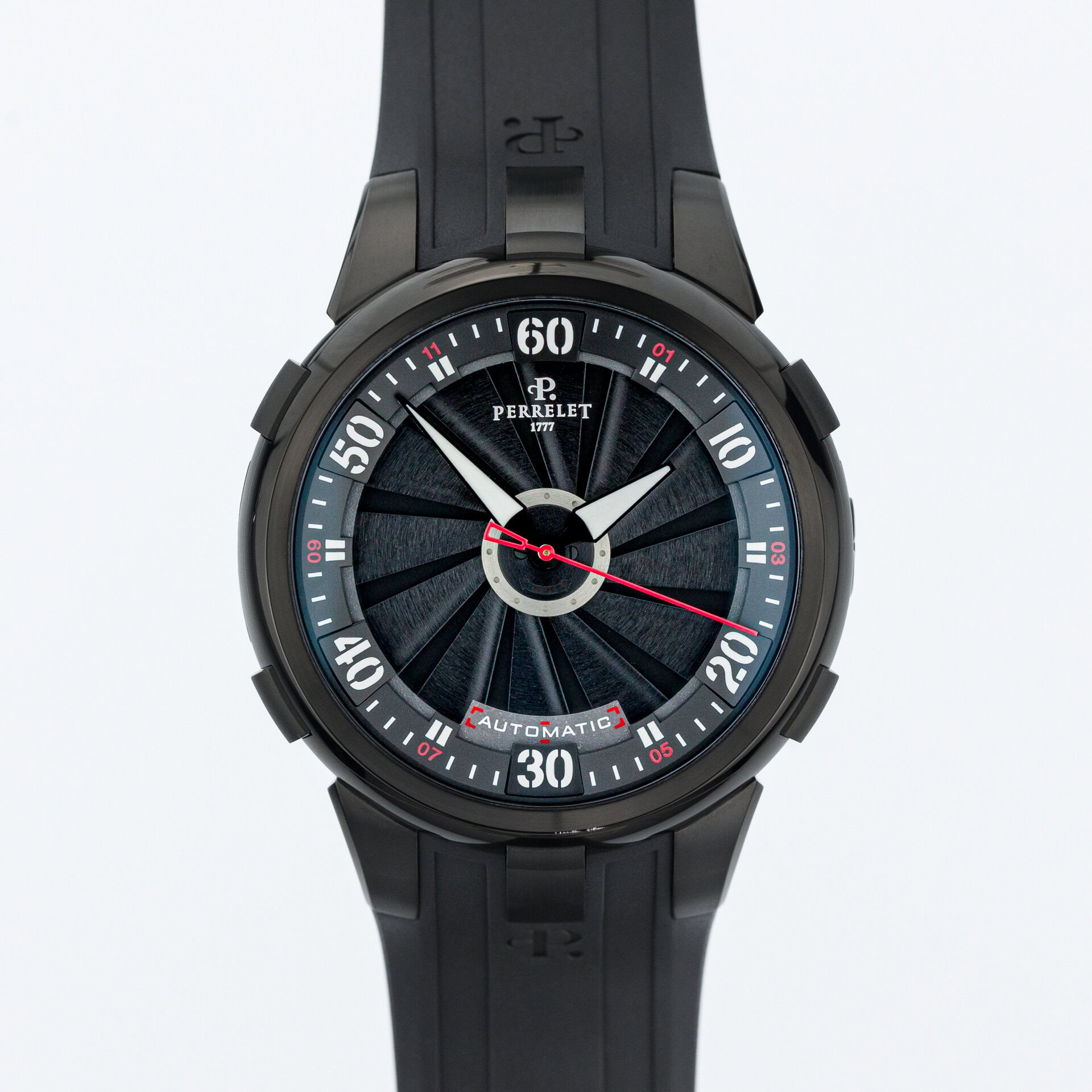
The “Turbine” series was first presented at Baselworld 2009 and with its appearance, it provoked great interest, but also a great polarization of opinions in watchmaking circles. Critics and analysts were given plenty to talk about. Reviews, articles, comparisons, and what not followed in all sorts of known and unknown publications. The bomb had been dropped.
And Perrelet did not hesitate to ride the wave and exploit to the maximum both the effect it caused and the good product. All sorts of variations on the Turbine theme followed – colors, sizes, limited editions – for all tastes (even the most eccentric) and audiences. Personally, in our opinion, in some cases they simply overdid it and went beyond the bounds of decency (as for example with the Erotic series – where the dial features hentai images!), but – “there's a passenger for every train”. Initially, the series had a case size of 44 mm, and subsequently (in 2012) the Turbine XL was launched in an impressive 50 mm and the Turbine Diver in its 47.5 mm and 300 m water resistance.
The turbine owes its origin to Perrelet's Double Rotor system, which was patented by the brand in 1997 and became one of Perrelet's signature features. As you can easily guess from the name, the system includes two rotors – one in the usual place for automatic movements – on the back of the movement, and the other (an additional rotor) is located on its front side, using the P-181 movement (Soprod with modifications) as a base. For the first turbine model (launched in 2009), Perrelet used the Double Rotor principle, but replaced the front rotor with a turbine consisting of twelve titanium blades. Later (in 2012), they replaced the movement with another and separated the turbine from the rear rotor, thus making the rotation of the “blade” with every movement of the hand much more prolonged, and the overall effect much more attractive.
We searched for a Turbine for a long time and during this period we noticed a very interesting fact: these timepieces are practically absent on the secondary market. In recent months, the number of pre-owned Turbines for sale can literally be counted on one hand. We cannot be certain of the reasons, but the fact remains.
But let's get back to the matter at hand – the watch presented is the Turbine Skeleton, which allows us to enjoy the exquisite craftsmanship of the movement from both the back and the front.
The model was first presented at Baselworld in 2012 and combines the market success of the Turbine series, the brand's heritage in the production of high-quality timepieces and movements, and the functionality of the brand's diver series.
The first thing that catches the eye of anyone who looks at this watch is, of course, the turbine itself. Unlike the diver turbines of the series, which more closely resemble a submarine propeller – with their slightly curved blades, this watch has the classic “jet engine” look and the number of blades is the classic 12 for the brand. The blades themselves are in tone with the main color of the watch – black – and are set in motion with ease at the slightest movement of the wrist. The hour and minute hands are large, massive, and again coated with a generous amount of SuperLuminova, while the seconds hand is finished in signal red.
As we have already mentioned, the main color of this particular model is matte black, and this is best suited to the watch's purpose.
The case measures 48 mm by 14.3 mm and despite its impressive size, the watch sits quite snugly on the wrist, thanks to the slightly curved case towards the practically non-existent bezel. The rubber strap combines very well with the steel case of the watch and fits the lugs with absolute precision – the impression is truly that of a single whole.
In the heart of the watch beats the automatic in-house P321 movement (Soprod A10 base), which, by the way, has powered all models in the Turbine collection since 2012. And through the transparent sapphire case back, you can enjoy this movement with Perrelet's now-signature decoration with the traditional Côtes de Genève, countless “P”s on the bridges, the skeletonized rotor with the brand's logo, etc.