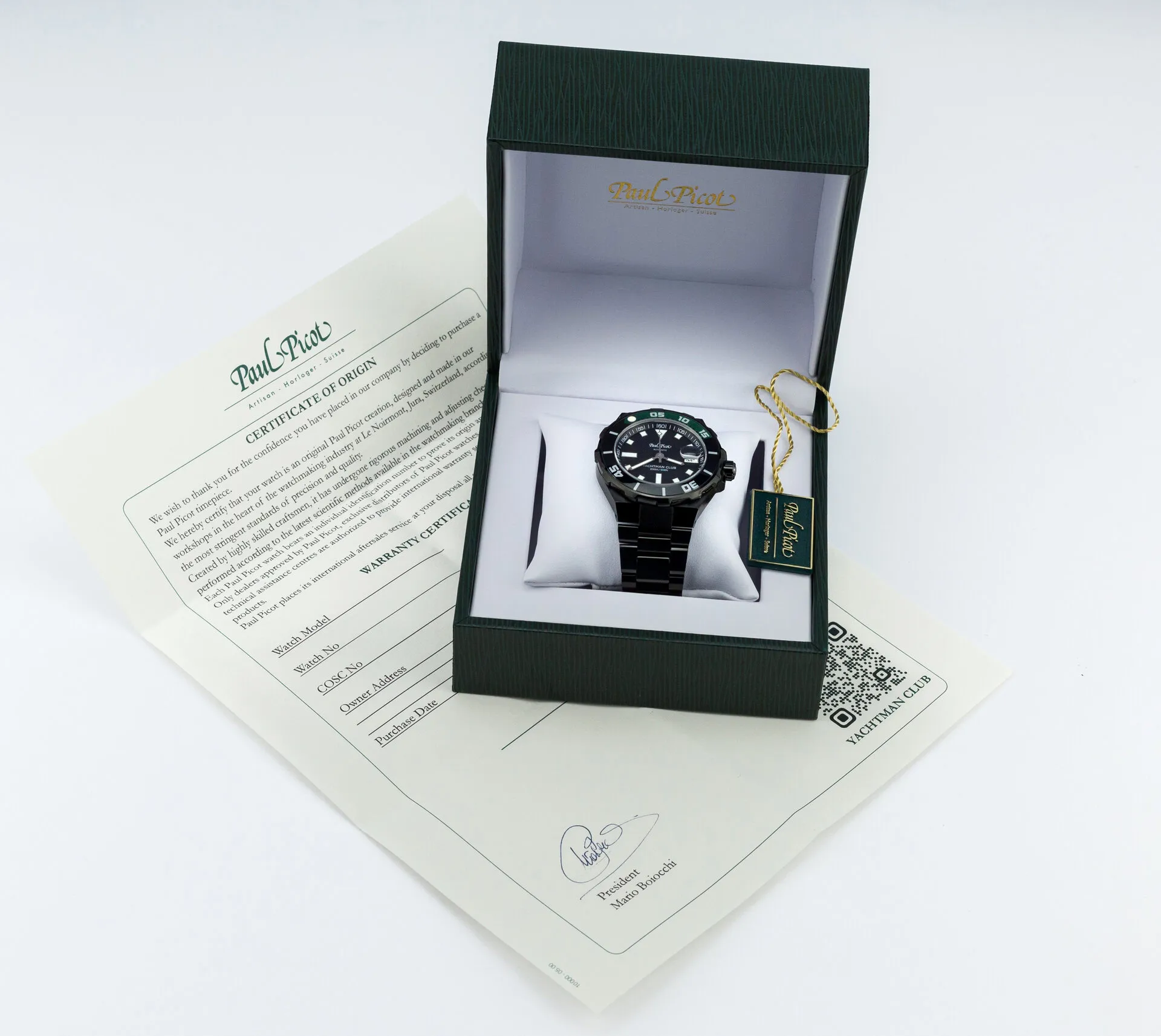
The Paul Picot brand was founded in 1976 by Mario Boiocchi—during one of the most difficult periods for traditional Swiss watchmaking. These were the years of the so-called quartz crisis, when mechanical watches faced serious competition from the more affordable and accurate electronic models from Japan and the United States.
While many established manufacturers tried to adapt to the new trends, Boiocchi took the opposite direction. He founded a company that placed traditional mechanical watchmaking, Swiss craftsmanship, and a characteristic Italian flair for design at its core.
The name Paul Picot was inspired by an 18th-century watchmaker and was intended to emphasize the young company's connection to the classic traditions of the craft. From the very beginning, the brand focused on watches with automatic and manual winding movements, gradually supplementing its catalog with sports chronographs, diver's models, and more complex horological constructions.
The Italian market proved to be particularly important for the development of Paul Picot. Thanks to the combination of Swiss mechanics and a bolder, recognizable design, the brand managed to attract an audience in a country known for its sense of style, fashion, and luxury goods.
Subsequently, operations were concentrated in Le Noirmont, in the Swiss Jura region—an area with deep watchmaking traditions. There, Paul Picot developed the design, assembly, and decorative finishing of its watches, also working with established specialized suppliers from the region.
In the early 1990s, the Technicum appeared—one of the most interesting and technically ambitious models in the brand's history. It is an automatic COSC-certified chronograph with a central additional hand, day and date indications, and a power reserve indicator. The model received numerous awards and gradually became one of the emblems of Paul Picot.
Another important model is the Firshire Tonneau, distinguished by its "tonneau" shaped case and the characteristic cut-out detail on the left side of the case. It was the Firshire Tonneau that won the "Watch of the Year" award in Germany in 1998.
Over the years, the Paul Picot catalog has expanded significantly. Among the brand's most recognizable collections are Technicum, Technograph, C-Type, Firshire, and Atelier. In them, one can find classic elegant models as well as sports watches, chronographs, regulators, and versions with various horological complications.
Paul Picot watches are distinguished by an interesting combination of traditional Swiss mechanics, an Italian feel for color and form, and relatively limited production. The brand never achieved the mass recognition of the largest Swiss manufacturers, but this is precisely what makes it interesting for people seeking a rarer and different timepiece.
An additional advantage is the ratio between quality, originality, and price. Especially on the secondary market, Paul Picot models often offer craftsmanship and technical characteristics that are difficult to find in more popular brands within the same price range.
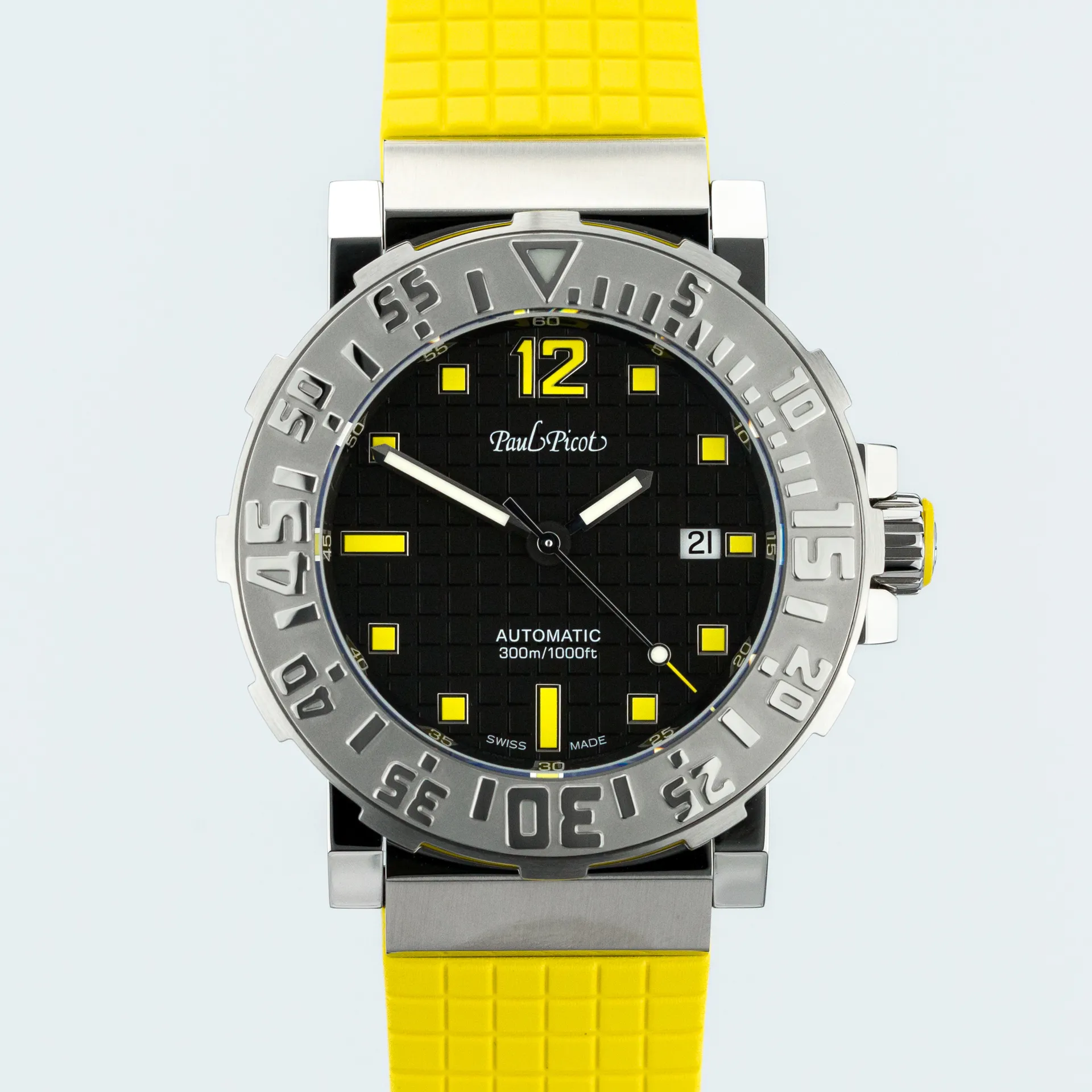
The first words that come to mind upon encountering this watch are "summer," "freshness," and "good mood."
This is one of those models that does not try to be discreet. The combination of a massive steel case, a black dial, and a bright yellow rubber strap gives it a character that can hardly go unnoticed.
For us, this is the almost perfect watch for summer adventures—from surfing and diving to a walk along the coast or a cold beer after a long day at the beach.
The case is made of stainless steel and has a diameter of 43 mm and a thickness of about 12.5 mm. The size is distinctly sporty, but the relatively moderate height allows the watch to sit well on the wrist and not look overly cumbersome.
The water resistance of 300 meters, the screw-down crown, and the unidirectional rotating bezel make the model a fully functional diver's watch, not just a sporty-looking accessory.
The black dial provides excellent contrast to the bright yellow details. The large hands and hour markers are coated with a generous amount of luminescent material, which facilitates reading the indications in low light as well as underwater.
The date window is located at 3 o'clock, and the dial is protected by a scratch-resistant sapphire crystal with an anti-reflective coating.
One of the most characteristic elements is the yellow rubber strap with a raised, waffle-like texture. It is perfectly complemented by the yellow accents on the dial and creates the feeling of a completely finished color concept.
The embossed steel bezel adds another interesting visual and tactile element. It is unidirectional, as expected from a true diver's watch, and is easy to operate even with wet hands.
The crown is protected by massive guards and is adorned with the "PP" logo. This is a small but important detail that shows the attention paid to the overall design of the watch.
Beneath the solid steel case back operates the automatic caliber PP 1400. It is based on a well-known Swiss automatic architecture, operating at a frequency of 28,800 vibrations per hour and offering a power reserve of approximately 40 hours.
The movement does not try to impress with an exotic construction or unusual complications. Its main advantages are reliability, good accuracy, and relatively easy and affordable maintenance—qualities that are particularly important for a watch intended for active use.
The Paul Picot C-Type Plongeur P4118.SNGN.3012 is a fresh, different, and fully functional sports watch. It combines 300 meters of water resistance, a sapphire crystal, a reliable automatic movement, and a design that brings a true summer mood.
This is not a model for someone looking for an inconspicuous watch. It is intended for those who like colors, an active lifestyle, and rarer Swiss brands—and who are not afraid for the watch on their wrist to attract attention.